There was a time when you could find Christopher Columbus staring back from your change. For generations, his stern profile on the half-dollar was a small, metallic tribute to the spirit of discovery and the dawn of the New World. But coins, like history books, are written by their time. The story of the Columbus Half Dollar is a fascinating journey from celebration to reconsideration, showing how a nation’s symbols evolve right along with its people.
Let’s dive into the rise and fall of this once-prominent coin.
The World’s Fair Coin: A Commemorative First
The story begins not in 1492, but in 1892. The United States was preparing for the World’s Columbian Exposition, a grand world’s fair in Chicago to celebrate the 400th anniversary of Columbus’s voyage. They wanted a spectacular souvenir, and so the Columbian Exposition Half Dollar was born.
This wasn’t just any coin. It holds a prestigious title: the very first commemorative coin ever issued by the United States Mint. It was a bold new experiment, creating a coin not just for commerce, but for memory.
For a small premium over its face value, Americans could own a piece of this national celebration. The coin was a hit, funding the exposition and landing in the pockets and display cases of thousands.

Reading the Metal: The Coin’s Design and Its Shifting Meaning
The coin’s design is a clear window into the era’s values.
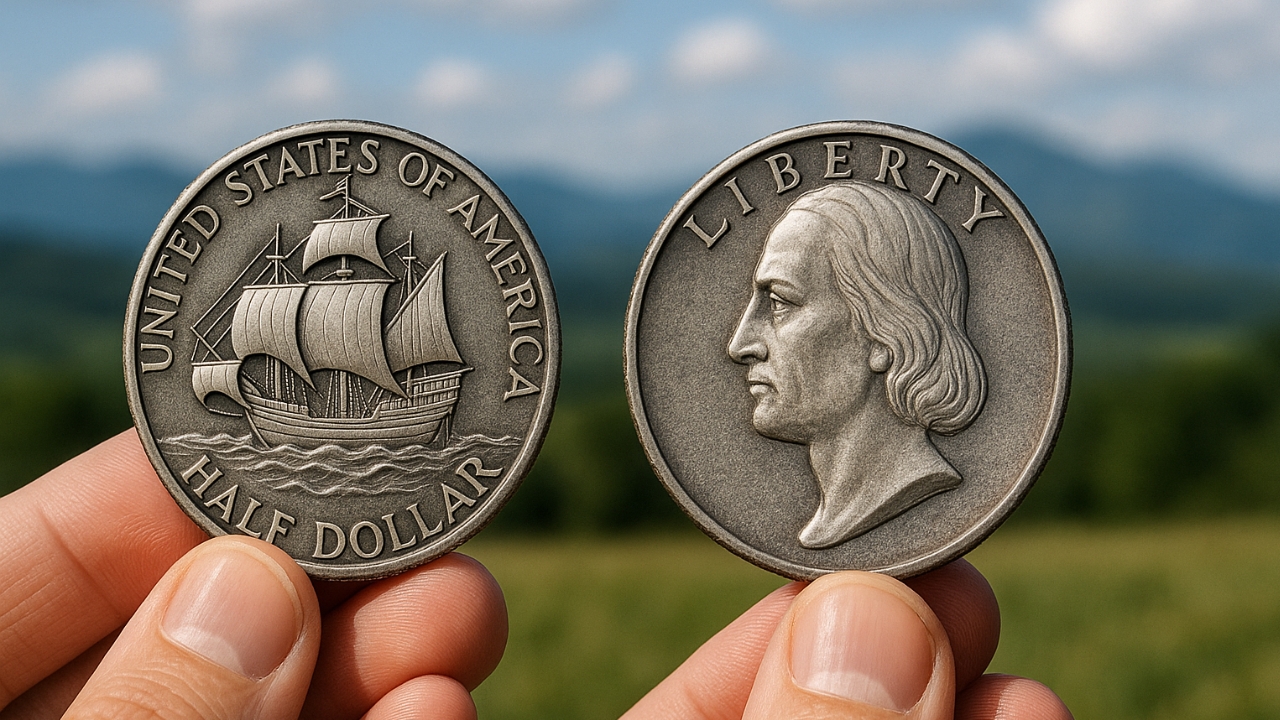
· The Obverse (Heads): Features a detailed, stern-faced portrait of Christopher Columbus, modeled after a statue in the Columbian Exposition. In the 1890s, he was largely presented as a heroic, intrepid explorer.
· The Reverse (Tails): Shows Columbus’s flagship, the Santa María, sailing westward. It symbolized adventure, progress, and the bridging of two worlds.
For decades, this was the accepted narrative. But as historical understanding deepened, the same design began to tell a more complex story. The “discovery” celebrated by the coin also marked the beginning of centuries of colonization, conflict, and suffering for Indigenous peoples. The noble explorer image was increasingly challenged, and the coin in your hand became a quiet, weighty piece of a much larger and more difficult conversation.
Why the Coin Disappeared: The Tide of Public Sentiment Turns
The Columbus Half Dollar wasn’t meant for permanent circulation. After the 1892-93 issue, it faded for a time, only to be briefly revived for a final curtain call.
The last U.S. coin to feature Columbus was the 1992 Columbus Quincentenary Half Dollar, marking 500 years since his voyage. But the America of 1992 was vastly different from that of 1892. The quincentenary was met with widespread public debate and protest. Celebrating Columbus felt, to many, like celebrating the beginning of cultural destruction.
The U.S. Mint, reflecting this profound cultural shift, quietly retired the theme. Public interest had waned, and the national conversation had moved toward a more inclusive and honest reckoning with history. The coin series that began with such fanfare ended not with a bang, but with a reflective whisper.
The Columbus Half Dollar at a Glance
| Feature | Details |
| Official Name | Columbian Exposition Half Dollar |
| Years Minted | 1892, 1893 (and a 1992 commemorative) |
| Significance | First U.S. Commemorative Coin |
| Metal Content | 90% Silver, 10% Copper |
| Obverse Design | Portrait of Christopher Columbus |
| Reverse Design | The Santa María over two hemispheres |
| Legacy Status | Discontinued; a collectible artifact |
A Collector’s Artifact Today
For modern collectors, the Columbus Half Dollar is a prized piece of Americana. Its value isn’t just in its silver content, but in the rich story it encapsulates. It represents a milestone in U.S. minting history and serves as a tangible record of America’s changing identity. Holding one is like holding a century of national conversation about discovery, legacy, and memory.
Conclusion: A Legacy in Silver, Not an Erasure
The disappearance of Columbus from our coinage isn’t an erasure of history. It’s the opposite—it’s history in action. It shows a nation growing, learning, and deciding which values it wants to enshrine in its most public symbols. The Columbus Half Dollar remains a crucial chapter in that story, a silver legacy of how we see our past, and how that vision is always, thankfully, under construction.
Frequently Asked Questions (FAQs)
1. Is the Columbus Half Dollar made of real silver?
Yes!Both the original 1892-93 issues and the 1992 commemorative are composed of 90% silver and 10% copper, making them popular with silver bullion and coin collectors.
2. Why was the 1992 half dollar controversial?
By 1992,the public understanding of Columbus’s impact had significantly changed. Many viewed his voyages as the start of the exploitation and devastation of Native American populations, making a celebratory commemorative coin feel inappropriate and offensive to a large segment of the population.
3. Are these coins rare and valuable?
While millions were minted in the 1890s,their value depends on their condition (grade). Common, worn examples can be found for a small premium over their silver value, while pristine, uncirculated coins can be worth hundreds of dollars. The 1992 proof versions are also sought after by modern collectors.
4. Who has replaced Columbus on U.S. coins?
The U.S.Mint has shifted towards honoring a wider range of American figures. Recent coin programs have featured individuals like George Washington, Sacagawea, and various U.S. states and national parks. The American Women Quarters program, for example, celebrates figures like Maya Angelou and Sally Ride, reflecting a move toward more diverse and inclusive representation.
5. Did any other U.S. coins feature Columbus?
Besides the half dollars,Columbus also appeared on a special $5 gold commemorative coin in 1892, which was also sold to raise funds for the World’s Fair. This is much rarer and more valuable than the half dollar.